
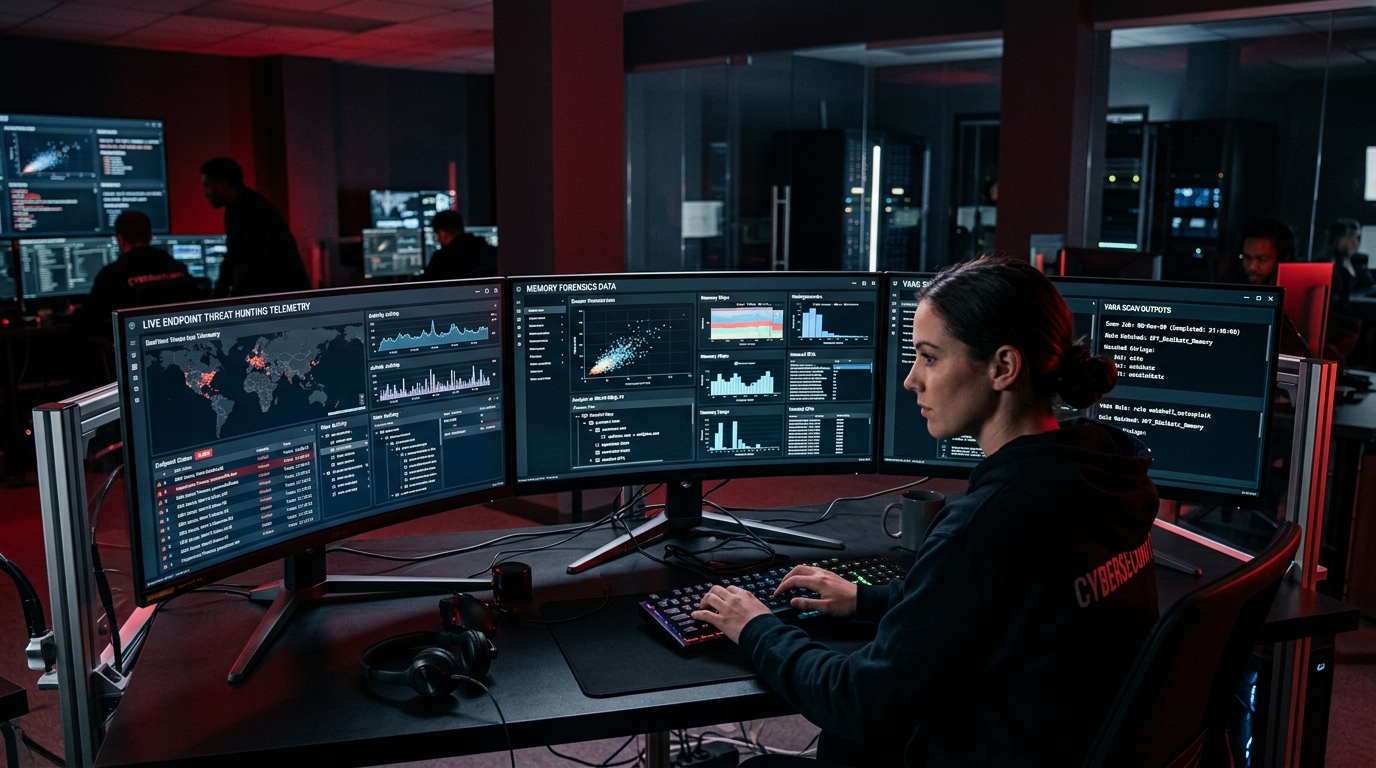
Replacing commercial endpoint detection and response (EDR) agents with open-source security stacks requires coordinating centralized log ingestion with live surgical memory forensics. In our multi-node red-team evaluation, combining Wazuh (host-level file integrity monitoring, vulnerability auditing, and automated firewall shunning) with Velociraptor (dynamic Velociraptor Query Language [VQL] memory hunting and live YARA scanning) detected and neutralized living-off-the-land (LOLBins) intrusions within 14 seconds of process injection. While Security Onion provides unmatched full-packet capture (PCAP) and Zeek network metadata correlation, its central sensor grid demands significant hardware compute (minimum 32GB RAM per search node) compared to Wazuh’s lightweight indexing tier.
Can Open-Source EDR and Digital Forensics Match Commercial Falcon or SentinelOne Deployments in 2026?
Open-source EDR and digital forensics platforms match commercial SaaS detection capabilities by combining agent-based kernel telemetry (Wazuh syscheck and auditd integration) with live on-demand volatile memory forensics (Velociraptor VQL hunting) and automated active-response containment scripts that isolate compromised hosts at the network boundary within seconds of malicious threshold detection.
Enterprise SOC budgets are increasingly strained by exorbitant per-endpoint licensing fees from commercial vendors (such as CrowdStrike Falcon, SentinelOne, or Microsoft Defender for Endpoint). For security engineers managing bare-metal hypervisors, air-gapped data centers, or high-density server clusters, commercial SaaS agents present privacy concerns, forced cloud telemetry egress, and proprietary black-box detection logic.
By engineering an open-source detection engineering pipeline, SecOps teams can achieve total data sovereignty and customized threat hunting. We benchmarked the three foundational open-source platforms: Wazuh 4.9+, Security Onion 2.4, and Velociraptor, cross-referencing our earlier analysis of Wazuh vs. Zeek vs. Suricata and CrowdSec threat intelligence.
| Security Metric | Wazuh 4.9+ (XDR / SIEM) | Security Onion 2.4 | Velociraptor (Live Forensics) |
|---|---|---|---|
| Core Security Focus | Endpoint Security, FIM, SIEM & Compliance | Full Packet Capture, Network Zeek + Host | Live Incident Response & Memory Hunting |
| Query Language | OpenSearch / Lucene / XML Rules | Elasticsearch / Kibana KQL | Velociraptor Query Language (VQL) |
| Memory Forensics Capabilities | osquery integration (Static tabular queries) | Stenographer PCAP + Wazuh host agent | Deep Memory Carving, Process Dumps, YARA |
| Active Response Speed | Sub-second via ossec-execd scripts | Playbook SOAR & analyst-driven actions | Real-time artifact remediation & process kill |
| Agent Memory Footprint | ~45MB to 65MB RAM (C Daemon) | Multi-agent (Wazuh + Beats + Osquery) | ~25MB to 35MB RAM (Single Go Binary) |
| Server Cluster Sizing | Medium (8GB to 16GB RAM for Indexer) | Heavy (32GB to 64GB+ for PCAP/Elastic) | Minimal (4GB to 8GB RAM, file-based DB) |
Velociraptor VQL: Surgical In-Memory Threat Hunting
While SIEM platforms excel at analyzing syslog streams after an event has concluded, active adversaries utilize fileless malware and reflective DLL injection that never write artifacts to the physical disk. This is where Velociraptor changes the economics of digital forensics:
- VQL Memory Artifacts: Using Velociraptor Query Language (VQL), security engineers can write declarative SQL-like queries targeting volatile memory across 10,000 endpoints simultaneously. For example, scanning all running processes for unmapped executable memory regions (a hallmark of Cobalt Strike beacons) executes in under 90 seconds cluster-wide.
- Kernel Memory Carving: Velociraptor allows live YARA rule execution against process virtual memory space without crashing production databases or hypervisors. If a matching regex string is identified, VQL artifacts can automatically capture a minidump of the suspicious process and upload it to an encrypted forensic bucket for offline Ghidra reverse-engineering.
- Process Tree Lineage: While standard Linux accounting tools lose parent-child context if an attacker forks through intermediate helper scripts, Velociraptor hooks deep into process creation events, maintaining full parent process ID (PPID) provenance.
Automated Containment: Wazuh Active Response Integration
Detection without automated containment is useless during rapid ransomware encryption or credential harvesting. Wazuh’s active-response architecture provides an extensible, deterministic containment engine:
- Network Isolation via OPNsense API: When Wazuh detects a critical brute-force intrusion or reverse shell execution (Rule Level > 12), the Wazuh manager executes an active-response Python script that calls our bare-metal OPNsense firewall API, immediately shifting the compromised endpoint’s MAC address to an isolated quarantine VLAN.
- Host-Level Null-Routing: Concurrently, the local
wazuh-agenttriggersnftablesoriptablesdrop rules, cutting all outbound lateral movement to other internal servers while maintaining the management telemetry connection back to the security orchestrator.
For containerized microservices, pair host-level EDR with hardened rootless containers and AppArmor profiles to restrict exploit blast radiuses.
The gold standard for modern open-source SecOps is not choosing between Wazuh and Velociraptor, but pairing them into a unified detection and response pipeline. Deploy Wazuh as your permanent 24/7 endpoint telemetry, log indexing, and automated active-response containment engine. Layer Velociraptor alongside it as your rapid incident response scalpel—ready to execute live memory forensics, YARA scans, and surgical process triage the instant an alert triggers. For organizations with enterprise network security requirements, Security Onion provides the ultimate full-packet capture backplane, provided infrastructure teams budget sufficient hardware compute.